What Security Is the Buyer Purchasing?
In a private-company secondary, an LP buys existing shares before a public exit. Their value depends on the share class and rights, while the seller's motives and transfer rules help explain the deal's risks. Carta's Q1 2026 State of Private Markets describes tender offers and other secondary deals that let holders sell while IPO access remains limited.
The opportunity is still a negotiated private security. Its share class and transfer rules determine what the buyer will own. The company's quality determines what that ownership may eventually be worth.
Many closed-end funds have a planned life of 8 to 12 years. When exits take longer than expected, secondary sales can become more important to holders who need cash.
An employee may offer common shares below the latest preferred-round price. The quote looks cheaper, but the preferred investors have downside protection and information rights that do not follow the common stock. The price gap therefore reflects two different securities as well as the buyer's opportunity.
How the Buyer Obtains Ownership
SEC Rule 144 generally uses a 6-month holding period for reporting issuers and 1 year for non-reporting issuers. Contractual restrictions can still make a private-company position less liquid.
“Secondary” describes how the position changes hands. A direct purchase can transfer a common or preferred share, while an SPV transaction transfers an interest in a vehicle that owns the company.
Some routes use forward contracts, while company-led tenders set their own eligibility rules. The asset the buyer legally owns determines which valuation and rights apply.
The transfer may depend on company consent or a right of first refusal. Reporting, voting, pro-rata and tag-along rights may also change hands differently from the shares themselves. These terms determine both whether the buyer can close and what it owns afterward.
Primary and Secondary Capital Serve Different Purposes
Primary shares bring new money into the business. Secondary shares move existing ownership to a new holder, leaving company cash unchanged in a pure secondary.
A company raises $20 million at an $80 million pre-money value. Its post-money value is $100 million. The new investors own 20% just after closing, before options or later dilution.
A $10 million purchase from an existing shareholder transfers ownership but contributes $0 to the company's balance sheet. That distinction matters when assessing runway and future financing risk.
Secondary prices are often compared with the last primary round. A common-share buyer may receive fewer rights than the preferred investors in that round. Those differences can explain some of a discount to the last funding round, reducing the apparent bargain.
Why the Holder Wants to Sell
Recent tender data shows how seller participation has changed. Across Carta tenders, median seller participation rose from 36.6% in Q1 2021 to 56% in the first half of 2025, while median subscription rose from 73.8% to 99.9%.
Organized tenders can attract more sellers as the private market matures. A higher seller count does not, by itself, signal deterioration at every company. Employees may want to diversify, while an older fund may need to return capital.
The timing of a sale can also reflect concern about future funding or an exit. This matters when insiders have better information and are reducing their stakes on terms the new buyer cannot obtain. The same offer can have several possible explanations.
How a Secondary Reaches Closing
Buyer and seller may agree on price before the company has approved the transfer. The transaction closes only after the governing documents and issuer process allow ownership to move.
- Ownership and security: The seller's title, share class and any liens or other claims determine what can be sold.
- Transfer rules: Company consent, another holder's right to buy first, buyer eligibility and other approvals can affect whether the transfer proceeds.
- Closing: The purchase agreement sets the conditions for the sale. Once those are met, payment and an update to the cap table or SPV register complete the ownership transfer.
A direct buyer holds the company security in its own name. An SPV stays between the buyer and the company. Its agreement sets vehicle fees and who can make decisions.
What the Business Can Sustain
Familiarity with a late-stage company gives only a starting point for understanding its value. The customer problem and the reasons the product wins help explain whether its success can last.
Revenue growth becomes more useful when retention and gross margin support it. Customer concentration shows how much of that progress depends on a few relationships.
Cash runway affects what happens after the purchase. If the company raises again soon, the new holder may be diluted before it has any chance to sell.
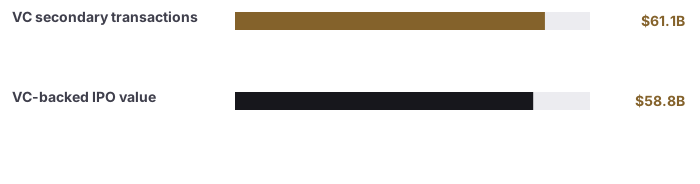
Private secondary volume has become comparable with, and recently exceeded, VC-backed IPO value. Carta estimates for the 12 months ending June 2025. The comparison describes market volume. Expected investment returns require a separate analysis.
Private Secondary Volume Versus VC-Backed IPO Value
Private secondary volume has become comparable with, and recently exceeded, VC-backed IPO value.
View chart data and assumptions
| Measure | Value |
|---|---|
| VC secondary transactions | $61.1B |
| VC-backed IPO value | $58.8B |
Why the Security Determines the Price Comparison
The label “secondary” can suggest a bargain, yet Carta's first-half 2025 tender data showed both the median and 25th-percentile discount at 0%, while the 75th percentile reached 15%. Current company evidence and the rights on offer explain value more reliably than the label alone.
Lower public-market prices may reduce the multiple used to value the company. The last preferred round may also include rights the buyer will not get.
The holding period and future dilution can reduce the benefit of a lower entry price. A 15% discount to an inflated reference price can still leave the buyer paying too much.
Information Access Matters
A formal tender offer generally remains open for 20 business days. The timetable keeps the process moving while the buyer reviews the current financials, cap table, and offered security.
Even a formal process may provide incomplete reports. Secondary buyers often receive less information than new-round investors. A large stake then rests on evidence that may support only limited confidence in the outcome.
A lower price may pay for uncertainty if the buyer can verify the security. If the cap table is missing or the security cannot be confirmed, it may be wiser to decline.
How Long the Buyer May Wait for Cash
An excellent company may remain private for years after the purchase. Its likely buyers and the state of the exit market help explain when the investor could realistically receive cash.
A strong market can bring an exit forward. A weaker one may leave the company raising again before a later sale at a lower value. Even an IPO may be followed by a lockup, so the listing date and the holder's first chance to sell can differ.
Governance and Conflicts
A sponsor may earn fees or carry for arranging the deal and may also know the seller. Those interests can shape its recommendation, alongside its view of the company.
The source of the shares and the transfer approvals explain how the opportunity reached the buyer. The sponsor's own stake and terms reveal whether it shares the same risks as the investors it invites.
When a Secondary Can Fit
A secondary can fit when the business case, security value and holding period suit the investor. The quality of the available evidence affects how much confidence it can place in that case and how large a stake makes sense.
Holdings through funds can add to the same company exposure, changing how a secondary fits the portfolio. The secondary sale evaluation memo template brings together the price, rights and approvals with gaps in information and the likely route to cash.
Stripe: Company-Organised Liquidity Without an IPO
Stripe signed a February 2024 tender offer at a $65 billion valuation to provide liquidity to current and former employees. Investors funded most of the purchase, while Stripe also used company capital to repurchase shares.
The deal set a company-approved price for a limited period when holders could sell.
Demand came from both outside investors and Stripe itself.
That mix let shareholders receive cash while Stripe stayed private.
A tender can improve transfer certainty and price discovery. Its documents still define eligible sellers, the share class, available information and the allocation and settlement terms. Those details determine what each buyer actually receives.
Primary sources: Stripe, employee liquidity tender (2024). The Stripe tender is cited from public records and is not presented as a Frontierspace result.
Frequently Asked Questions
How should an investor assess a secondary discount?
The relevant comparison depends on share class and the full capital structure. A discount to the latest preferred round may offer little value when the purchased security has weaker rights.
What can delay liquidity in a private-company secondary?
Company consent and rights of first refusal can delay a transfer. Buyer eligibility rules may narrow the market further. Limited information and a later company exit can extend the holding period again.