How Do Anti-Dilution Provisions Work?
Anti-dilution terms offer some protection when a company raises money at a lower share price. They adjust the price at which preferred shares convert to common. This shifts some of the loss to founders, employees and other holders. It does not prevent all dilution.
Down rounds represent a minority of venture financings. They remain common enough to model before investing. Cooley's Q4 2025 Venture Financing Report found that the proportion fell from the previous quarter as more companies raised flat or up rounds.
Within Cooley's sample of 221 financings, 12.8% were down rounds in Q4 2025, compared with 19.3% in Q3. The sample covers one law firm's transactions rather than the whole market. It shows that lower-priced rounds still occur, which is when an anti-dilution clause can begin to affect ownership.
The Adjustment Happens Through Conversion
Preferred shares in a venture financing usually have the right to convert into common shares. At the outset, one preferred share may convert into one common share. A qualifying lower-priced issuance can change that ratio by reducing the conversion price attached to the earlier preferred stock.
Assume the original conversion price is $10. At that price, one preferred share converts into 1.0 common share. If a full-ratchet provision resets the price to $5, the same preferred share can convert into 2.0 common shares because $10 divided by $5 equals 2.0.
The company does not repay part of the original investment. Instead, the protected holder receives more common shares if it converts. That extra share count can affect ownership, voting power, and exit proceeds long after the down round has closed.
- The trigger is usually price: The provision applies to covered issuances below the conversion price.
- It does not freeze ownership: A protected investor may still be diluted in a new financing, only less than an investor without the adjustment.
- Legal basis: The certificate of incorporation usually sets the conversion rules. Other agreements may give holders rights to join later rounds or approve decisions.
Weighted Average Versus Full Ratchet
The calculation can respond to the down round in two very different ways. A weighted-average formula asks how many cheap shares were issued relative to the existing capitalization. A full ratchet ignores the size of the issuance and resets the protected price to the new lower price. The NVCA Yearbook describes venture financing terms using the same two categories.
- Broad-based weighted average: This uses a wider share count. It generally includes common shares, preferred as if converted, options and warrants. The charter defines what counts.
- Narrow-based weighted average: This uses a smaller share count. The same down round can then produce a larger adjustment.
- Full ratchet: Resets to the lower issuance price without weighting the adjustment by the number of new shares sold.
- No price-based adjustment: Existing holders face normal dilution. Their conversion price stays the same.
The chart keeps the company and funding round the same. Only the anti-dilution rule changes, so you can compare the formulas' effects.
In this calculated down-round example, one million preferred shares remain convertible into one million common shares with no adjustment. Broad-based weighted average raises the conversion amount to roughly 1.091 million shares. Full ratchet raises it to two million. The example assumes a $10 prior conversion price, 10 million fully diluted pre-round shares, and two million new shares sold at $5 for a $10 million financing.
The Same Down Round, Three Conversion Outcomes
Full ratchet produces a much larger conversion adjustment than broad-based weighted average when a new round is priced 50% below the prior conversion price.
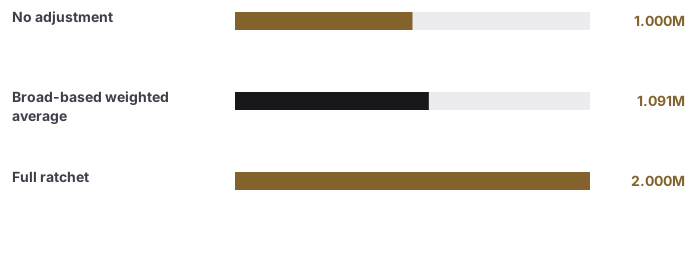
View chart data and assumptions
| Treatment | Adjusted conversion price | Common shares per preferred | Common shares from 1.0M preferred |
|---|---|---|---|
| No adjustment | $10.00 | 1.000 | 1.000M |
| Broad-based weighted average | $9.17 | 1.091 | 1.091M |
| Full ratchet | $5.00 | 2.000 | 2.000M |
Why the Denominator Matters
The label 'broad-based' does not say exactly which shares count. The charter defines the pre-round base, including how it treats common and preferred shares, options, warrants and convertibles. A wider base generally produces a smaller adjustment because the new cheap shares make up less of the total.
In the illustrated case, the company begins with 10.0 million fully diluted pre-round shares and a $10 conversion price. It then sells 2.0 million shares at $5 to raise $10 million. Applying the disclosed broad-based formula produces a new conversion price of about $9.17. The number of common shares received for each protected preferred share increases from 1.0 to roughly 1.091.
- Including all preferred shares, granted and ungranted options, warrants and convertibles produces a different base from a count that leaves some out.
- Deemed issuance price: A note, SAFE, warrant or bundle of securities may need special rules to work out the amount paid per share.
- Differences between series: Preferred series may have different conversion prices, protections and rights to waive an adjustment.
- Rounding and timing: Small wording differences can build up in effect when adjustments happen more than once.
Excluded Issuances Can Be Decisive
A low price alone may not trigger the clause. Charters often exclude employee grants, shares from existing convertibles, shares used to buy a business and other agreed issues. Two companies can sell shares at the same low price yet face different adjustments because their exclusions differ.
- Employee equity: Shares or options issued under an approved equity plan may be excluded, sometimes only up to an agreed pool size.
- Existing instruments: The terms may exclude shares issued when an existing option or warrant is exercised, or a note or other instrument converts.
- Business deals: Shares issued to buy a company, finance equipment, arrange bank funding or form a strategic partnership may have specific rules.
- Stock changes: Splits and stock dividends generally have their own rules to adjust shares in proportion. They do not use the down-round formula.
Suppose the company issues 4.0 million shares at $2.50 and raises $10 million. Using the same 10.0 million-share pre-round base, including the issuance in the broad-based formula lowers the conversion price from $10.00 to about $7.86. If the charter excludes the issuance, the conversion price remains $10.00. The commercial event is identical; the drafting changes the result.
Pay-to-Play, Waivers, and Amendments
A down round involves negotiation as well as a formula. New investors may require existing holders to invest again, waive an adjustment or approve a new capital structure. Voting thresholds and pay-to-play rules affect whether those changes can happen.
Cooley reported pay-to-play provisions in 6.3% of the financings in its Q4 2025 sample, down from 9.9% in Q3. These dated figures describe Cooley's transactions, but they illustrate a practical point: the value of anti-dilution protection may depend on whether the holder is willing and able to invest again.
- Pay-to-play: A holder that does not invest may lose its anti-dilution rights. Its shares may convert to common or move to another preferred series. The agreed terms set the penalty.
- Waiver rights may rest with a class, a series or preferred holders as a whole, changing who can give up the adjustment.
- Funding talks: A company that needs cash may agree a wider change to its capital structure. The existing formula is one part of that bargain.
- Rights given to a particular holder can affect its investment, consent or access to reports even when the charter terms stay the same.
From the Clause to the New Ownership Split
The clause begins to matter when a financing meets its trigger. Its formula then sets a new conversion price, which changes the cap table and can alter the proceeds received at exit. Each step relies on the terms and share counts used in the one before it.
- Protected series: Original issue price, current conversion price, conversion ratio and shares outstanding define each series' starting position.
- Trigger and exclusions: The definition of additional stock and the rules for deemed prices determine whether an issue causes an adjustment.
- The common-equivalent share count reflects the current cap table and the outstanding instruments included under the clause.
- Price adjustment: The old conversion price, new funding price, consideration and shares issued supply the inputs for the formula.
- Ownership change: No adjustment, the agreed adjustment and a proposed waiver can produce different ownership percentages and voting power.
- Exit proceeds: Conversion choices interact with liquidation preferences, payment priority and participation. Debt and deal costs reduce the amount left to share.
What the Protection Costs Other Holders
The name of the clause tells the investment committee very little on its own. A broad-based formula with a large denominator may barely move the conversion price. A full ratchet can shift much more dilution to founders, employees, and unprotected investors.
- The actual security: A label such as "broad-based weighted average" describes a method. The signed terms and share counts determine what that method does in the deal.
- Consistent share counts: The formula, option pool, convertibles, warrants and new-money terms describe parts of the same cap table. Conflicting counts can distort the apparent protection.
- Different funding paths: A small down round may cause a modest adjustment. A large change in the capital structure can have a greater effect, while an excluded strategic share issue may cause none.
- Incentives: Protecting one class may shift dilution to founders, employees and other holders. That can affect whether staff stay and how easily the company raises again.
Protection for one investor can leave others with less reason to support the company. The revised cap table affects employees' remaining stake and the appeal of another funding round. A clause that helps one holder may therefore make the company's recovery harder.
Frequently Asked Questions
Does anti-dilution protection prevent all dilution?
Price-based protection generally softens the effect of certain new shares issued at a lower price. It does this by changing the conversion terms. It does not keep ownership at a fixed percentage through every share issue.
Is broad-based weighted average always company-friendlier than full ratchet?
Broad-based weighted average usually has a smaller effect because it accounts for round price and size. Full ratchet resets to the lower price. The signed definitions still matter: a small share base or unusual exclusions can make a weighted-average change large.
Can an anti-dilution adjustment affect an exit?
A lower conversion price gives the holder more common shares on conversion. That can change the exit value at which converting pays more than taking the preference. It can also change how the cash left over is shared.
Which documents should investors review?
The certificate of incorporation describes the rights, and the current cap table shows who holds them. The term sheet, stock purchase agreement and investors' rights agreement add context. Voting documents, side letters and option records may alter the result, as may outstanding convertibles. Together, these records explain how the clause applies.
This article provides general information. It does not provide personalized legal, tax, or investment advice. Actual rights and outcomes depend on the legal documents, applicable law, and the facts of the financing.