How Vintage Pacing and Commitment Planning Work Together
Commitment pacing spreads new fund commitments over years. A manager may raise its next fund before the earlier one returns much cash, adding a new request to the LP's existing obligations. A forecast of the whole programme shows how those demands overlap within the target allocation.
Commitment planning sets how much the LP can approve, while vintage pacing spreads that sum across years and repeat investments with managers. The annual budget is therefore part of a longer forecast of holdings and unpaid commitments. The cash-flow pattern described by the venture capital J-curve helps explain why those commitments can remain outstanding for years.
Cambridge Associates' benchmark materials group results by vintage year and asset class. Timing affects the deals available and how long funds have had to develop. Committing heavily in one year can leave an LP reliant on that period's prices and exit market.
Fund lives often run 8 to 12 years. A commitment approved today can therefore affect the LP's cash needs well beyond this year's budget.
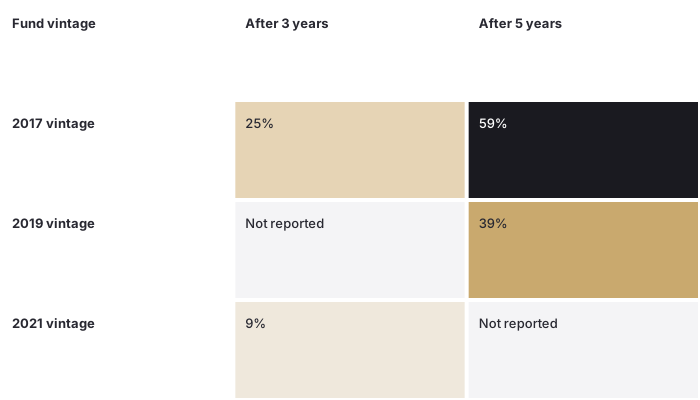
Recent fund vintages have generally taken longer to begin distributing capital, reinforcing the need for cash planning. Share of Carta-tracked funds that had begun generating any DPI at the stated age. Blank cells were not reported in the cited analysis.
How Quickly Fund Vintages Began Generating DPI
Recent fund vintages have generally taken longer to begin distributing capital, reinforcing the need for cash planning.
| Fund vintage | After 3 years | After 5 years |
|---|---|---|
| 2017 vintage | 25% | 59% |
| 2019 vintage | Not reported | 39% |
| 2021 vintage | 9% | Not reported |
View chart data and assumptions
| Fund vintage | After 3 years | After 5 years |
|---|---|---|
| 2017 vintage | 25% | 59% |
| 2019 vintage | Not reported | 39% |
| 2021 vintage | 9% | Not reported |
Suppose an LP commits $30 million across managers. Their next funds may open before the first ones return much cash. A forecast covering only the first commitments misses that extra demand. Likely re-up dates and delayed distributions explain why the eventual funding need can be larger.
A commitment is larger than the first cash call
Cambridge Associates says private investments are commonly locked up for 10 years or more. Each year's decisions add to the last. Earlier promises still have to be funded when the committee reviews a new vintage.
A $10 million commitment called at 25% in year 1 requires $2.5 million of immediate cash and leaves $7.5 million unfunded. The remaining amount is still a legal portfolio obligation even though its timing is uncertain.
Paid-in capital shows what has already been funded. Unfunded capital shows what may still be requested. The pacing model needs both, together with any recallable distributions allowed by the fund documents.
Different Vintages Bring Different Entry Conditions
Four annual commitments of $10 million place a $40 million programme into 4 market environments. One $40 million commitment concentrates the same capital in a single vintage.
The regular schedule does not guarantee better returns. It reduces dependence on one pricing and exit cycle and creates room to learn from the earlier relationships before the programme is fully built.
How Re-Ups Change Concentration
If 5 managers begin with equal commitments, each represents 20% of planned capital. Doubling the re-up to one manager raises its share to 33.3% if the other 4 remain unchanged.
A strong manager may merit a larger stake, though earlier funds and unpaid commitments already use part of the budget. New evidence, cash returned and the latest fund's role explain whether more exposure adds value.
When Calls Continue but Distributions Stop
Calls can continue while public markets fall and few exits occur. In that setting, the LP relies on liquid assets to meet its promises. Private holdings may not sell at reported NAV, or at all. A plan dependent on expected exits is therefore more exposed to timing than one backed by available cash.
Base, Upside, and Downside Cases
| Case | Assumption To Test |
|---|---|
| Base | Expected call pace, reserve use, and ordinary exit timing. |
| Upside | Earlier distributions and stronger DPI from realized winners. |
| Downside | Delayed exits, continued calls, lower NAV, and limited secondary liquidity. |
Which Scenario Can the Committee Fund?
The base case shows the expected call pace and ordinary exits. The downside delays distributions while calls continue and NAV falls. If no cash returns for 3 years, how much additional exposure can the portfolio still afford?
That answer sets the capacity for re-ups, new managers, and discretionary co-investments. It also makes clear which relationships receive capital and which must wait. LPs can test the schedule in the venture commitment pacing calculator, then turn the approved assumptions into a repeatable governance record with the private equity commitment pacing plan template.
A Public-Pension Timing Case: Commitments Spread Across Market Cycles
ILPA's public-pension case study makes the pacing problem visible across time. It used publicly available data for commitments from 2002 through 2016 and placed annual commitment levels beside vintage-year performance.
The disclosed example spans 2002 through 2016 and therefore covers several fundraising years.
Across that period, commitment amounts varied materially from one year to the next.
The study showed each year's commitments as a share of the private-assets portfolio. That allowed comparison between years even as the portfolio grew or shrank.
The performance labels describe historical results. The case illustrates why timing spans several years: commitments and calls follow different schedules, while distributions, NAV growth and market cycles can move independently.
Primary sources: ILPA, public-pension commitment timing case study. The public-pension records illustrate commitment timing and have no connection to Frontierspace performance.
Frequently Asked Questions
Is an annual venture commitment the same as annual cash outflow?
A commitment is a legal promise to fund. The manager decides when to call for cash, and exits drive when cash comes back. Paid capital and the amount still owed therefore explain different parts of the LP's cash needs. Reinvestment, fund extensions and slow exits can tie up cash long after the commitment year.
Why diversify venture commitments across vintage years?
Spreading commitments across years reduces reliance on one set of entry prices and exit conditions. It also builds the portfolio more steadily through market cycles.